 sales@sanjiantools.com


 中文简体
中文简体 Deutsch
 Español
What Is Brass Wire Brush For Rust Used For In Cleaning Work
Rust often appears quietly on metal surfaces after long exposure to air, moisture, and changing environments. Once it starts forming, the surface texture shifts, becoming rough and uneven, which can affect later coating, repair, or assembly work. Cleaning tools designed for rust removal become part of routine maintenance in workshops, construction areas, and equipment servicing environments.
Brass Wire Brush For Rust is commonly used in such situations where controlled surface cleaning is required. Instead of cutting deeply into the metal, brass wire provides a softer contact approach that helps remove oxidation layers while keeping the underlying surface relatively stable. In many maintenance routines, it sits between heavy abrasion tools and light cleaning pads, filling a practical middle role.
Wire Brush Cleaning Tool appears across different cleaning tasks where surface preparation matters. Rust removal is only one part of its usage range, yet it remains one of the more frequent applications due to how metal surfaces behave over time.
Why rust removal becomes part of routine surface work
Metal does not remain unchanged in real working conditions. Exposure to air and moisture slowly alters the surface, especially in areas where protective layers are thin or missing. Rust formation often starts in small patches, then expands outward across uneven surfaces.
In maintenance environments, cleaning is not only about appearance. Surface condition affects later steps such as painting, coating, welding preparation, and mechanical fitting. Without removing oxidation layers, later treatment may not hold evenly or may lose stability over time.
Brass Wire Brush For Rust is often selected in these situations because surface interaction remains controlled rather than aggressive. The tool does not aim to reshape the metal, only to remove unwanted surface buildup.
Common reasons rust cleaning becomes necessary:
- preparation before coating or protective treatment
- restoration of equipment surfaces after exposure
- cleaning of joints and connection points
- removal of surface irregularities during repair work
- maintenance of mechanical parts with visible oxidation
What defines Brass Wire Brush For Rust in practical use
A wire brush built with brass material behaves differently compared to harder wire structures. The flexibility and softness of brass allow contact with metal surfaces in a more controlled manner, especially when working on parts that cannot tolerate deep abrasion.
Instead of scraping aggressively, the brush works through repeated surface contact, gradually loosening rust and oxidation. This makes it suitable for tasks where surface preservation matters alongside cleaning effectiveness.
Key characteristics in practical use:
- controlled abrasion on metal surfaces
- reduced risk of deep surface marking
- suitable for light to moderate rust layers
- adaptable to flat and uneven surfaces
- stable performance during repeated movement
Wire Brush Cleaning Tool in brass form often becomes part of manual maintenance kits, especially where surface precision matters more than fast removal.
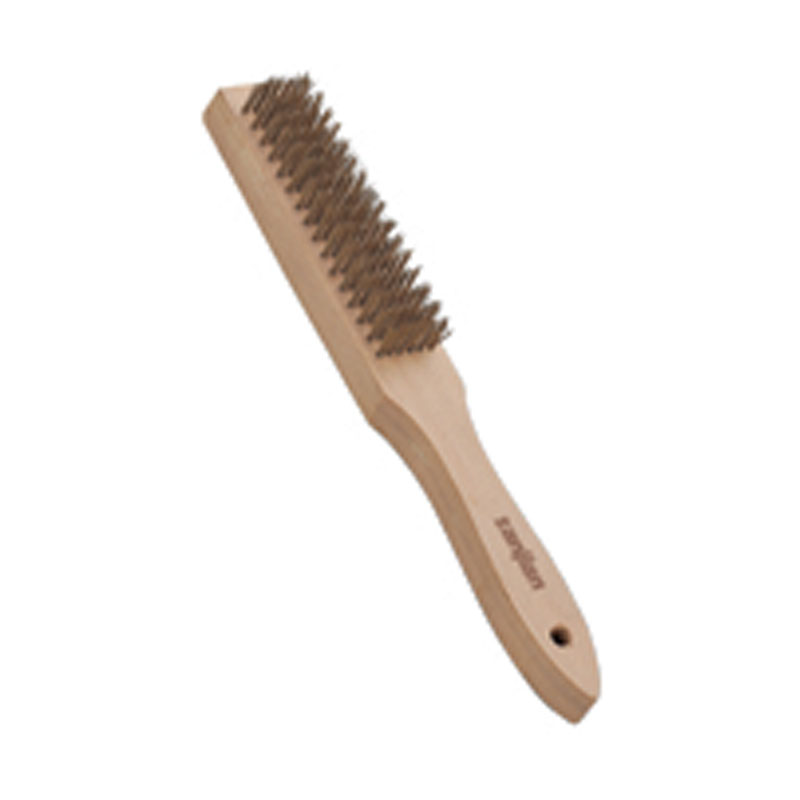
How Brass Wire Brush For Rust interacts with metal surfaces
Rust layers do not form evenly. Some areas remain thin, while others build thicker, flaky textures. When a brass wire brush moves across such surfaces, contact points vary continuously, which allows gradual removal instead of sudden surface change.
The motion of cleaning usually follows repeated strokes or circular movement, depending on surface shape and accessibility. As contact continues, loose particles separate from the surface and fall away, leaving a cleaner layer underneath.
General interaction pattern:
- initial contact loosens surface oxidation
- repeated motion breaks rust clusters
- fine particles detach gradually
- underlying metal becomes visible
- surface texture becomes more uniform
Wire Brush Cleaning Tool is often used in combination with manual observation, adjusting pressure based on how the surface responds during cleaning.
Where Wire Brush Cleaning Tool appears in maintenance work
Cleaning tools based on wire structures are not limited to rust removal alone. They appear in many maintenance environments where surface preparation is part of a larger workflow. Brass Wire Brush For Rust is one variation used when softer contact is preferred.
Typical application areas include:
- metal equipment surface cleaning
- pipe and tube maintenance work
- construction site surface preparation
- workshop repair activities
- restoration of aged metal parts
- pre-treatment before coating or bonding
In many of these environments, cleaning is not a final step. It supports later processes, which makes surface condition more important than appearance alone.
Which wire brush forms are used in different cleaning conditions
Wire brushes come in multiple structures depending on how the surface is accessed and how the cleaning force is applied. Brass wire versions follow similar structural variations.
| Brush Type | Common Use Condition | Surface Access |
|---|---|---|
| Handheld brush | General surface cleaning | Open flat areas |
| Narrow brush | Tight or confined spaces | Small gaps and joints |
| Wheel brush | Mechanical or rotating systems | Continuous surface contact |
| Extended handle brush | Hard-to-reach zones | Deep or blocked areas |
Wire Brush Cleaning Tool design often reflects the need to reach different surface angles rather than relying on a single movement style.
What role surface preparation plays in cleaning work
Rust removal is often part of a larger preparation process rather than a standalone task. Once a surface is cleaned, it may undergo coating, bonding, or mechanical assembly. The quality of cleaning directly influences how well later steps perform.
Brass Wire Brush For Rust helps create a surface condition that supports these later processes by removing unstable layers and leaving a more consistent texture.
Surface preparation usually involves:
- removing oxidation layers
- clearing loose particles
- evening out surface irregularities
- preparing contact zones for treatment
Wire Brush Cleaning Tool becomes part of a sequence rather than a single action, supporting transition between raw surface and treated surface.
How pressure and movement affect cleaning outcome
Cleaning performance is not only determined by the tool itself. Pressure, angle, and movement style influence how rust is removed from the surface. Light pressure may only clean surface dust, while stronger contact reaches deeper oxidation layers.
Movement style also changes results. Straight strokes tend to clean broader areas, while circular motion focuses on localized buildup.
Common factors affecting outcome:
- applied pressure level during contact
- movement direction across surface texture
- duration of cleaning on each section
- surface hardness and rust thickness
- tool condition during repeated use
Wire Brush Cleaning Tool usage often requires adjustment during operation, depending on how the surface reacts.
Why material selection changes cleaning behavior
Different wire materials create different surface reactions during cleaning work. Brass wire sits in a softer range compared to harder metallic options, which changes how contact pressure transfers onto the surface. Instead of cutting deeply, contact tends to stay more controlled, which suits surfaces that need cleaning without heavy abrasion marks.
Brass Wire Brush For Rust is often chosen in situations where metal surfaces require gradual cleaning rather than aggressive scraping. The wire bends slightly during use, and that flexibility helps distribute force across a wider contact area. Surface response becomes smoother, especially on parts that already carry wear or uneven texture.
Material differences can be viewed in a simple way:
| Wire Material Type | Surface Impact Level | Typical Use Behavior |
|---|---|---|
| Brass wire | Light to moderate contact | Controlled rust removal |
| Hard steel wire | Strong contact | Heavy oxidation removal |
| Coated synthetic wire | Soft contact | Light cleaning and dust removal |
Wire Brush Cleaning Tool made from brass often fits into maintenance tasks where surface preservation matters alongside cleaning function.
How Wire Brush Cleaning Tool fits into maintenance routines
Maintenance work rarely depends on a single action. Surface cleaning usually appears as part of a chain that includes inspection, repair, and preparation for next-stage treatment. Brass Wire Brush For Rust becomes one step inside that chain rather than a standalone process.
In many working environments, cleaning starts after surface inspection. Rust spots are identified, then treated in sections instead of removing everything at once. This staged approach helps maintain control over surface condition.
Typical workflow pattern:
- surface inspection and marking
- targeted rust cleaning using wire brush
- removal of loose particles
- secondary surface check
- preparation for coating or assembly
Wire Brush Cleaning Tool often remains part of a basic toolkit because it supports flexible use across different surface conditions without requiring complex setup.
How surface condition affects tool selection
Not every rust layer behaves the same way. Some surfaces show thin oxidation that can be removed quickly, while others develop layered buildup that requires repeated contact. Tool selection depends heavily on how the surface responds during initial cleaning attempts.
Brass Wire Brush For Rust is commonly used when surface condition is uneven or partially worn. Instead of forcing a single cleaning approach, operators adjust movement and pressure based on visible surface changes.
Factors that influence tool choice:
- thickness of oxidation layer
- surface hardness and wear level
- accessibility of cleaning area
- need for surface smoothness after cleaning
- follow-up treatment requirements
Wire Brush Cleaning Tool selection often becomes a balance between control and cleaning strength rather than a fixed choice.
How modern maintenance practices influence cleaning tools
Maintenance approaches have gradually shifted toward surface preservation and repeatable cleaning cycles. Instead of aggressive removal in one step, more controlled cleaning sequences are used. Brass Wire Brush For Rust fits into this approach due to its moderate contact behavior.
In many environments, cleaning is now connected with preparation planning. Surfaces are not only cleaned for appearance but prepared for bonding, coating, or mechanical fitting. That shift changes how tools are applied and how often they are reused.
Common practice changes include:
- more frequent light cleaning cycles
- reduced surface damage during preparation
- increased attention to surface texture consistency
- integration of manual and mechanical cleaning steps
Wire Brush Cleaning Tool usage becomes part of ongoing maintenance rather than occasional repair work.
How Brass Wire Brush For Rust supports long-term equipment care
Metal surfaces that remain in service over time require repeated attention. Rust does not only appear once; it returns under similar environmental conditions. Cleaning tools therefore become part of a recurring maintenance cycle.
Brass Wire Brush For Rust supports this cycle by allowing repeated use without causing deep surface changes. Over time, equipment surfaces can be cleaned multiple times while still keeping functional integrity.
Typical long-term care behavior:
- periodic rust removal from exposed areas
- cleaning of joints and connection points
- maintenance of surface texture before coating renewal
- gradual restoration instead of full surface replacement
Wire Brush Cleaning Tool often becomes part of routine inspection kits used during scheduled maintenance visits.
How cleaning tools evolve with application needs
As equipment design becomes more compact and surface conditions vary across different materials, cleaning tools adapt in structure and handling style. Wire-based tools remain widely used due to their direct contact behavior and simple operation.
Brass Wire Brush For Rust continues to be relevant in situations where controlled abrasion is preferred over strong mechanical scraping. Its role stays connected to surface preparation rather than deep material removal.
Evolving usage tendencies include:
- more focused cleaning on specific surface zones
- combination with portable maintenance tools
- adaptation to confined or irregular spaces
- emphasis on surface readiness for next process stage
Wire Brush Cleaning Tool remains part of this evolving maintenance structure, supporting surface care across different environments without complex operational requirements.

-
 +86-13906791151
-
 sales@sanjiantools.com
-
 No.1 Xinggong Road, Huangzhai Town, Pujiang County, Zhejiang Province, China


Client
Copyright © Zhejiang Pujiang Sanjian Tools Co., Ltd. All Rights  浙公网安备33072602100309号
Reserved.
浙公网安备33072602100309号
Reserved.

Construction Paint Tools Factory