 sales@sanjiantools.com


 中文简体
 Deutsch
 Español
How Does Blade Material Influence Utility Knife Cost and Cutting Performance?
A utility knife used to open cardboard boxes has very different demands from one used to cut rubber, plastic sheets, or industrial packaging. Some blades are cheap enough to replace frequently. Others cost more but stay sharp longer or cope better with moisture.
The steel makes much of this difference. Carbon steel, stainless steel, and specialty alloys each have their own advantages, and the price often reflects how the material is processed as much as the material itself.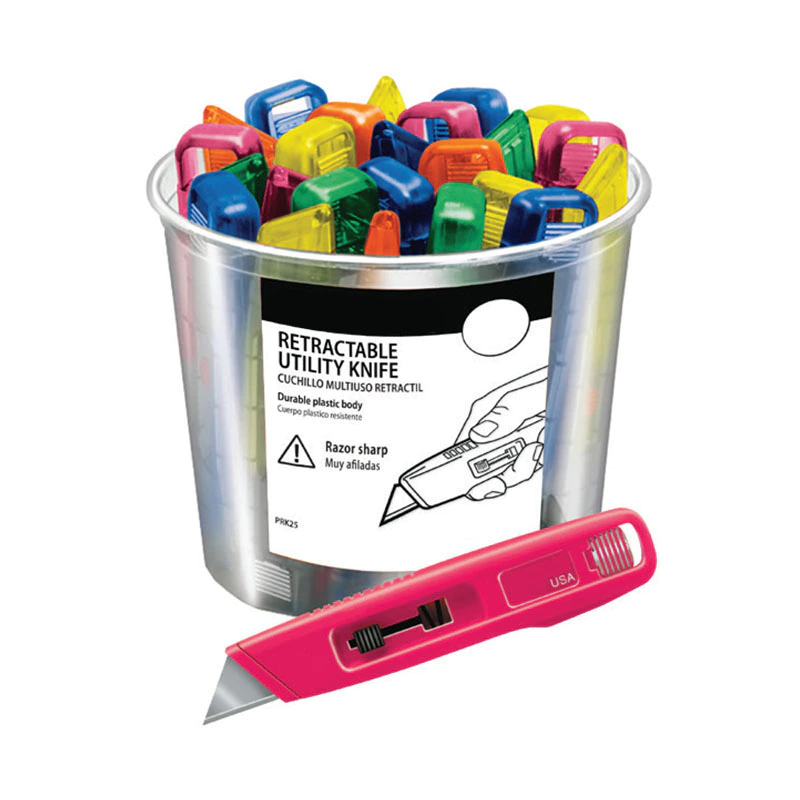
Why Blade Material Matters
A blade needs a hard cutting edge, but hardness isn't everything. If the steel is too brittle, the edge can chip under pressure. If it is too soft, it rounds off quickly and needs frequent replacement.
Wear resistance, toughness, corrosion resistance, and the ability to hold an edge all affect how a blade performs. These properties also explain why two blades with similar dimensions can have noticeably different prices.
Common Materials Used in Utility Knife Blades
Carbon Steel
Carbon steel is a common choice for disposable and replaceable utility blades. It can be hardened effectively, takes a sharp edge, and is relatively inexpensive to manufacture.
It works well for everyday jobs such as cutting cardboard, paper, film, and packaging. Its weakness is rust. In damp warehouses or workshops, blades need dry storage and suitable packaging. Otherwise, corrosion can affect the cutting edge before the blade is even used.
Stainless Steel
Chromium gives stainless steel its ability to resist corrosion. This makes it useful in workshops, food-related environments, and other places where blades may encounter moisture.
Its cutting performance depends on the particular grade and heat treatment. Stainless steel is not automatically harder or longer-lasting than carbon steel. Some grades also require more processing, which can raise manufacturing costs.
High-Carbon Stainless Steel
This type of steel combines carbon for hardness with chromium for corrosion resistance. Depending on its composition and heat treatment, it can provide good edge retention without being as vulnerable to rust as ordinary carbon steel.
It is often used where blades see repeated use and need to maintain a consistent cutting edge. The actual performance still depends on manufacturing quality rather than the material label alone.
Specialty Alloy and Coated Blades
Certain applications call for alloy steels with specific combinations of hardness, toughness, and wear resistance. Some blades also receive surface coatings, including titanium-based coatings, to improve surface properties or reduce friction.
A coating does not turn poor steel into a high-performance blade. The substrate, heat treatment, coating adhesion, and edge grinding still determine much of the result.
Comparing Blade Materials by Cost and Performance
| Blade material | Cutting characteristics | Corrosion resistance | Relative cost | Common use |
|---|---|---|---|---|
| Carbon steel | Takes a sharp edge; good general cutting performance | Low to moderate | Low | Cardboard and packaging |
| Stainless steel | Varies with grade and heat treatment | Good | Medium | Damp working environments |
| High-carbon stainless steel | Good hardness and edge retention | Good | Medium to high | Repeated professional use |
| Specialty alloy steel | Can offer greater wear resistance and toughness | Depends on grade | High | Demanding industrial work |
| Coated steel | Depends on the base steel and coating | May be improved | Medium to high | Specific cutting applications |
These are broad comparisons. Steel composition, heat treatment, blade thickness, and edge geometry can make two blades of the same material perform quite differently.
Heat Treatment and Blade Geometry
The steel grade is only part of the manufacturing process. Hardening and tempering determine the final balance between hardness and toughness. Poor temperature control during heat treatment can leave a blade brittle or unable to retain its edge.
Grinding also makes a noticeable difference. A narrow edge angle cuts with less resistance but is more vulnerable to damage when cutting tough materials. A wider angle provides more support, although it may require greater cutting pressure.
Blade thickness affects handling too. Thin blades can enter materials more easily, while thicker blades offer greater rigidity. The suitable design depends on what the user cuts often.
What Blade Material Means for Operating Costs
A low-priced blade isn't necessarily the cheaper option over time. Consider a warehouse that cuts hundreds of cardboard boxes every day. A lower-cost carbon steel blade may be perfectly adequate, even with frequent replacements.
In a damp production area, however, rust can make stored blades unusable. Paying more for stainless steel may be worthwhile in that situation.
When comparing costs, look at blade consumption, replacement labor, storage conditions, and downtime caused by dull or damaged edges. A simple cutting trial using the actual workplace materials can reveal more than a specification sheet.
What OEM Buyers Should Check
Before ordering in bulk, ask the manufacturer for the steel grade, hardness range, blade dimensions, and heat-treatment specifications. For coated products, request details about the coating process and adhesion testing.
| Quality factor | What to verify |
|---|---|
| Steel grade | Material specification or certificate |
| Hardness | Test results and acceptable range |
| Edge quality | Cutting consistency across samples |
| Corrosion resistance | Suitable test results when required |
| Dimensions | Length, width, thickness, and tolerances |
| Batch consistency | Inspection records and traceability |
Blade fit should not be overlooked. Confirm compatibility with the intended handle, blade holder, and replacement mechanism before approving the order.
Choosing a Blade for the Intended Job
For everyday packaging work, carbon steel is often sufficient. Stainless steel makes more sense where moisture is a concern, while high-carbon stainless steel and specialty alloys may suit applications involving more frequent or demanding cutting.
When sourcing utility knife blades, compare actual cutting results, edge life, and replacement frequency rather than relying on material names alone. A blade that costs slightly more but lasts longer may reduce the cost of keeping tools in service.

-
 +86-13906791151
-
 sales@sanjiantools.com
-
 No.1 Xinggong Road, Huangzhai Town, Pujiang County, Zhejiang Province, China


Client
Copyright © Zhejiang Pujiang Sanjian Tools Co., Ltd. All Rights  浙公网安备33072602100309号
Reserved.

Construction Paint Tools Factory