 sales@sanjiantools.com


 中文简体
 Deutsch
 Español
Can an Electric Welding Brush Manufacturer Provide OEM and Private Label Services?
Walk into any distributor's catalog and you'll notice something: a lot of welding brushes look suspiciously similar. Same shapes, same wire, same packaging. The difference between one supplier's product and another's often comes down to what happens before manufacturing starts—whether the factory can actually work to your specifications instead of just slapping your logo on whatever's already on the shelf.
That's the real question behind OEM and private label. An Electric Welding Brush Manufacturer may offer customization, branding, packaging design, production to agreed specs. But the scope varies widely. Some factories do little more than print your name on a standard brush. Others get involved in engineering, sampling, testing. Knowing which kind of supplier you're talking to matters more than the quotation sheet suggests.
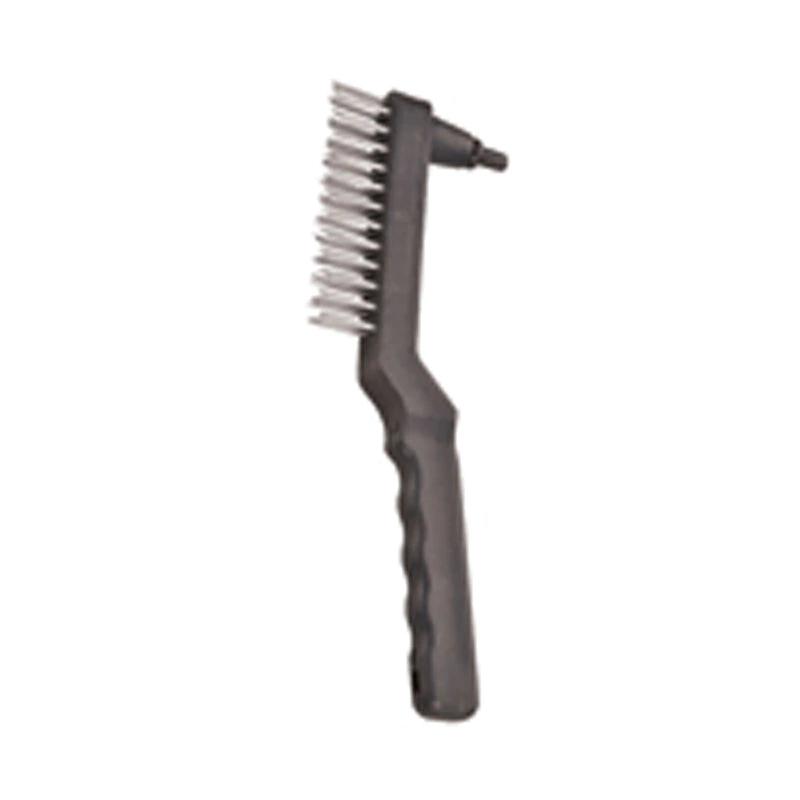
What OEM and Private Label Services Mean
The two terms get used interchangeably, which causes confusion. OEM usually means the factory builds to your design—your drawings, your performance criteria, your samples. You define what the product needs to do, and the manufacturer figures out how to make it consistently. Private label is lighter. You're buying an existing product, maybe with minor tweaks, and selling it under your brand. Logos, labels, cartons, instruction sheets. That sort of thing.
Some suppliers blur the line. They'll adjust brush dimensions, swap wire materials, change handle configurations—provided tooling and production limits allow it. But an OEM project generally requires more back-and-forth on the technical side. Private label leans on designs that already exist. Neither is better. They just serve different purposes, and buyers should be clear about which one they're actually asking for.
Which Welding Brush Features Can Be Customized?
Quite a few, depending on construction and application. But here's the thing—customization without context is risky. Explain the workpiece material, welding process, cleaning task, operating environment first. Otherwise the manufacturer is guessing, and guessing leads to brushes that don't perform.
Brush material is a common starting point. Stainless steel, carbon steel, brass, other wire types—each suits different cleaning requirements. Pick wrong and you risk contamination on the workpiece. Wire diameter and configuration matter too. Filament thickness, crimped versus straight wire, fill density—they influence how aggressive the brushing action feels and how long the brush lasts.
Shape and dimensions follow the same logic. Cup, wheel, end, hand-brush formats serve different access needs and surface-prep tasks. Mounting and connection details—arbor holes, threaded connections, shank dimensions—have to match the tool or the brush won't run safely. And branding, packaging, labels, barcodes, cartons, instructions: those can usually be customized without much trouble.
What shouldn't be assumed is that every change works for every product. Modify wire type or brush geometry and you affect aggressiveness, balance, wear, safe operating speed. Technical changes need review and testing before anyone commits to mass production.
How to Assess a Manufacturer's OEM Capability
A factory that can print your logo isn't necessarily an OEM partner. Look for evidence it can translate requirements into repeatable production specs.
| Evaluation area | Questions to ask | Why it matters |
|---|---|---|
| Engineering support | Can the supplier review drawings and samples? | Helps confirm feasibility before production |
| Material control | Can wire grades and dimensions be documented? | Supports consistent brush performance |
| Production capability | What brush types and sizes can the factory make? | Establishes whether requirements can be met |
| Quality inspection | Are dimensions, balance, and workmanship checked? | Reduces batch variation |
| Packaging services | Can labels and cartons follow brand guidelines? | Supports market-ready delivery |
| Order management | What are the MOQ and Delivery cycle? | Helps with inventory planning |
Ask for technical datasheets, material declarations, sample products, inspection details. For powered brushes, rated speed information is non-negotiable—make sure the product suits the tool. Assuming a customized brush is safe at a given RPM without manufacturer confirmation is asking for trouble.
Why Samples and Testing Matter Before Bulk Orders
A pre-production sample tells you whether the brush fits the tool and does the job. Check dimensions, mounting compatibility, wire retention, vibration, surface finish, wear under representative conditions. Not just "does it look right."
Testing should follow intended use and relevant safety requirements. Powered wire brushes shed filaments and particles. Users need guards, eye and face protection, procedures. The brush must not exceed its marked or specified rated speed.
Repeated industrial use raises another issue: consistency across samples. One good sample doesn't guarantee every batch will meet the same bar. Agree on measurable acceptance criteria before approving mass production. Put it in writing.
Understand Order Quantities, Delivery Timelines, and Costs
OEM and private label work often carries setup costs—artwork, packaging, tooling, special materials. MOQs shift depending on customization level and the manufacturer's process.
Get a quotation that breaks things down: product cost, customization charges, packaging, sample fees, shipping terms. Clarify artwork and sample approval, production timeline after approval, how changes get handled. And establish upfront how rejects, defects, warranty claims will be managed. Written specs and a documented quality agreement prevent arguments later about what "acceptable" means.
Protect Brand Consistency With Clear Specifications
Private label lives or dies on repeatability. Both sides should maintain an approved spec covering dimensions, wire material, connection details, packaging artwork, labeling, inspection criteria. Any change afterward needs documented approval.
Ownership of custom drawings, molds, packaging designs, brand assets—clarify that too. Confidentiality and IP terms belong in the supply agreement where appropriate. These details carry extra weight when the product is exclusive to a distributor or equipment brand.
Choose a Partner That Can Support the Full Project
An Electric Welding Brush Manufacturer may provide OEM and private label services, but support depth varies. Some factories mainly apply branding to standard products. Others assist with specification development, sampling, testing, packaging, ongoing quality control.
Before committing long-term, confirm technical capabilities, request samples, review inspection records, agree on written specs. A supplier that communicates clearly and controls production consistently is the one worth building a welding brush range around.

-
 +86-13906791151
-
 sales@sanjiantools.com
-
 No.1 Xinggong Road, Huangzhai Town, Pujiang County, Zhejiang Province, China


Client
Copyright © Zhejiang Pujiang Sanjian Tools Co., Ltd. All Rights  浙公网安备33072602100309号
Reserved.

Construction Paint Tools Factory