 sales@sanjiantools.com


 中文简体
 Deutsch
 Español
How Do Wire Diameter, Trim Length, and Brush Density Affect Different Types of Wire Brushes?
Wire brushes are everywhere—metal fab, auto repair, welding, surface prep, industrial cleaning. They knock off rust, scale, paint, burrs, whatever's clinging to a surface. But how well a brush works isn't just about shape or material. Wire diameter, trim length, brush density—those three things change how aggressive the brush cuts, how flexible it feels, what finish you get, and how long it lasts.
Get those parameters right and you'll match the brush to your equipment and job. Get them wrong and you're either scratching stuff you shouldn't or wasting time on a brush that's too soft.
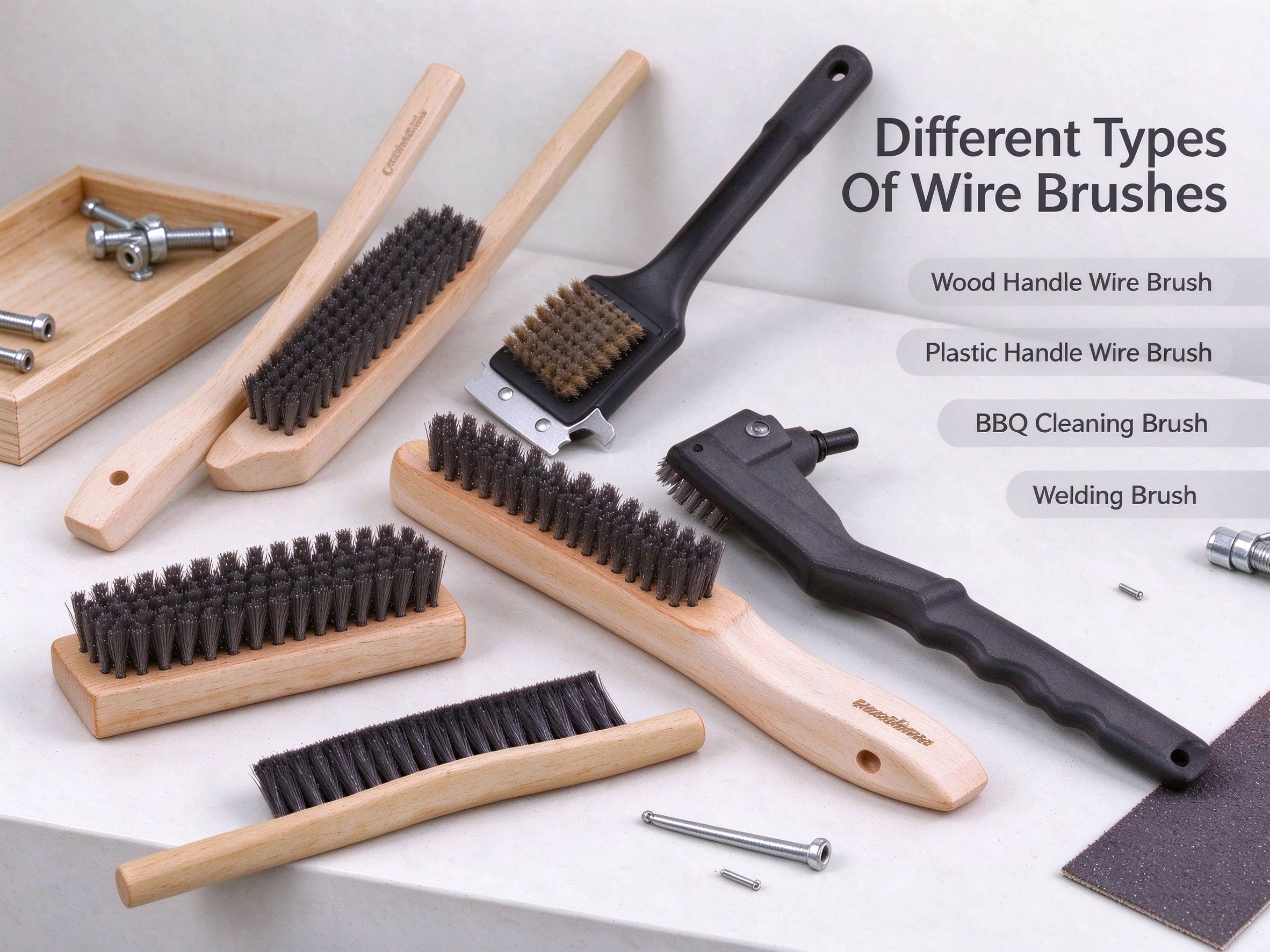
Why Do Wire Diameter, Trim Length, and Brush Density Matter?
Wire diameter = stiffness of individual bristles. Trim length = how much wire sticks out. Brush density = how tightly packed those wires are.
These work together. Thick wires with short trim? Stiff, aggressive action. Fine wires with longer trim? More flexible, good for delicate surfaces or weird contours. You also need to think about wire material, brush shape, operating speed, and what you're actually trying to do.
How Does Wire Diameter Affect Cleaning Performance?
Wire diameter drives bristle stiffness and how much force hits the workpiece. Small changes make a noticeable difference, especially on thin or precision parts.
Thicker wires are stiffer, more aggressive. Good for heavy rust, weld scale, stubborn deposits. They hold up under demanding jobs if you pick the right brush. But they can scratch softer materials and don't reach narrow gaps well.
Thinner wires flex more, adapt to uneven surfaces. Often used for light deburring, cleaning delicate components, removing loose junk without gouging. They give a finer finish, but wear out or deform faster under heavy use.
Which diameter? Depends on material, contamination level, desired finish. Check with the brush maker, especially for precision work.
How Does Trim Length Influence Flexibility and Reach?
Trim length is how much wire extends from the brush body. It affects how easily bristles bend when they touch a surface.
Longer trim = more flexibility. Wires follow curves, reach uneven surfaces, adapt to changing geometry. Useful for irregular castings, contoured parts, anywhere you want a gentle brushing action. Trade-off: less stiffness. Long wires deflect under pressure, so aggressive cleaning suffers.
Shorter trim = stiffer brush, more direct contact. Effective for demanding cleaning on accessible surfaces, controlled concentrated action. But less flexible in grooves, corners, intricate shapes.
When picking trim length, consider working space, surface shape, contact pressure, machine setup. Pressing too hard to compensate for flexy bristles just increases wear and ruins the finish.
How Does Brush Density Affect Contact and Surface Finish?
Brush density = how many wires are packed into the working area. Depends on wire count, tuft arrangement, spacing.
High density means more wires per area. Contact spreads across more bristles, giving a more uniform brushing pattern. Nice for consistent cleaning and finishing over larger areas. But greater density increases resistance, which loads the motor and generates heat. Closely packed wires can also trap debris, so cleaning and maintenance matter more.
Lower density gives more space between bristles. Individual wires move more, access improves in some spots. Good for localized cleaning or when flexible contact is needed. But the contact pattern can be less uniform.
Pick density based on coverage needed, contamination level, surface condition, available machine power.
How Do These Features Affect Different Types of Wire Brushes?
Brush geometry determines how diameter, trim length, and density translate into real performance.
| Brush type | Suitable design considerations | Common applications |
|---|---|---|
| Wire cup brush | Wire stiffness and density influence coverage and aggressiveness. | Rust removal and weld cleaning on broad surfaces. |
| Wire wheel brush | Diameter, trim length, and wire flexibility affect contact and reach. | Edge cleaning, deburring, and surface preparation. |
| End brush | Wire density and trim length influence precision and access. | Cleaning corners, holes, recesses, and confined areas. |
| Hand wire brush | Wire diameter and trim length determine manual control. | Light rust removal and general maintenance. |
| Knot wire brush | Stiffer, twisted wire bundles provide aggressive localized action. | Heavy scale and demanding weld cleaning. |
These are guidelines, not rules. Brush construction, wire material, operating conditions shift results. Stainless wire helps avoid carbon-steel contamination on stainless workpieces. Brass wire is common for softer metals.
How Can Buyers Choose the Right Wire Brush Specifications?
Start with the result you need. Heavy corrosion removal? Stiffer construction. Fine finishing? More controlled contact.
Five things to check before ordering:
- Workpiece material: hardness, surface sensitivity, contamination risks.
- Cleaning objective: rust removal, deburring, weld cleaning, finishing?
- Surface geometry: brush shape and trim length for the accessible area.
- Equipment compatibility: max rated speed, mounting dimensions, machine power.
- Service life: expected wear, maintenance needs, replacement frequency under real conditions.
For critical jobs, test a representative brush on a sample. Check cleaning effectiveness, surface damage, finish consistency, operating behavior before approving the spec.
Maintain Wire Brushes for Safe and Consistent Performance
Even a well-specified brush performs poorly if wires are damaged, contamination builds up, or you run it outside rated limits. Inspect before use. Replace damaged units. Follow speed and mounting requirements. Use guards and proper eye, face, and other PPE.
By balancing wire diameter, trim length, and brush density against the workpiece and cleaning objective, buyers can select Different Types Of Wire Brushes more accurately, improve process consistency, and cut avoidable tool replacement costs.

-
 +86-13906791151
-
 sales@sanjiantools.com
-
 No.1 Xinggong Road, Huangzhai Town, Pujiang County, Zhejiang Province, China


Client
Copyright © Zhejiang Pujiang Sanjian Tools Co., Ltd. All Rights  浙公网安备33072602100309号
Reserved.

Construction Paint Tools Factory